 Image 1 of 5
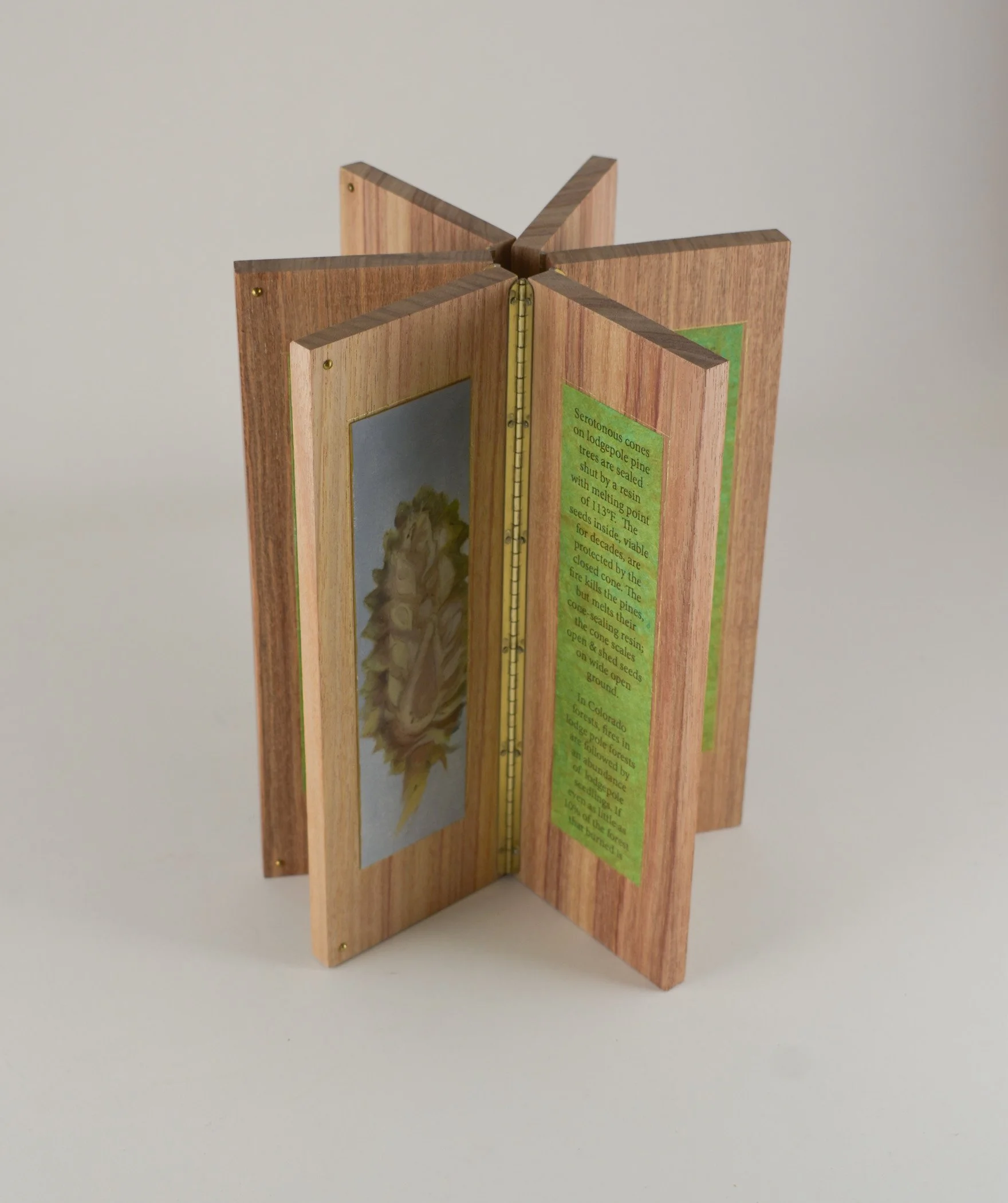 Image 2 of 5
 Image 3 of 5
 Image 4 of 5
 Image 5 of 5
Lodgepole Pine
© 2025
Edition of unique artists book
Dimensions in inches (closed): 9.25 x 3.88 x 3.25
Materials
Book: canary wood, brass, paper, stamping foil, oil paint, paste paper, laser toner, fusion foil
Box: book board, surface treated book cloth, paste & relief printed paper, stamping foil
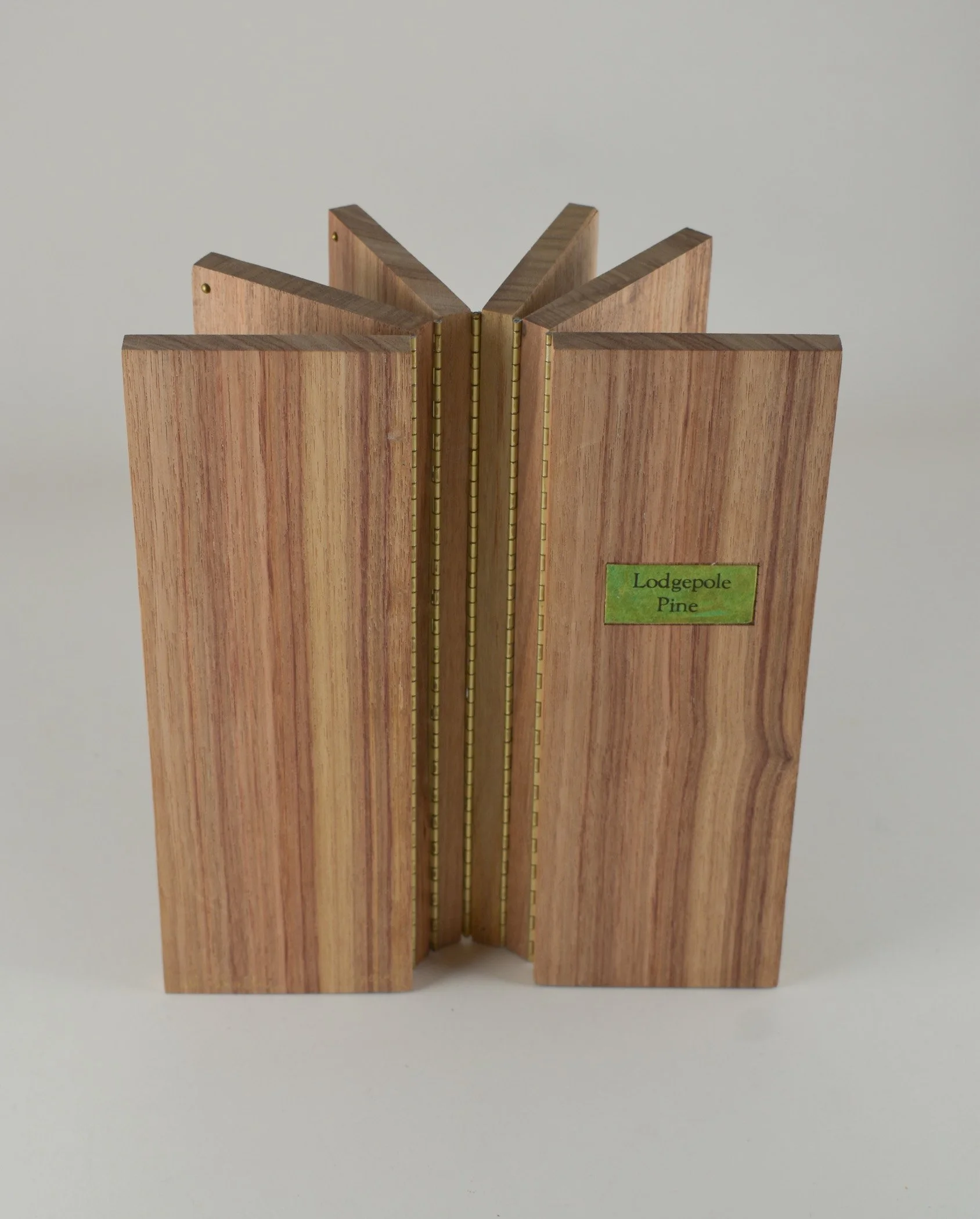
Six wooden planks, hinged with brass piano hinges, carry fact and narrative about the lodgepole pine alongside original oil on paper paintings. Housed in custom drop-spine box
Full text:
The first summer I lived in the San Juan mountains, I lived in a tipi. We erected the tipi on a snowy Memorial Day; our tipi poles the stripped lengths of lodgepole pine harvested from nearby forests. This was before the widespread infestation of the mountain pine beetle; the forests were filled with lodgepole.
The lodgepole pine grows tall & straight; chameleon like in its choice of habitat. Based on its common name alone, the choice of lodgepole pine for tipi poles is an easy one to make. Its scientific name, Linus contorta, celebrates another attribute — crookedness. Some posit that the contorta epithet comes from the tendency of each pair of bunched needles to twist away from each other.
As a fire-adapted, pioneer species, lodgepole pine has evolved to live in environments where fire is
predictably common, using a remarkable & effective fire strategy - serotony. Serotonous cones on lodgepole pine trees are sealed shut by a resin with melting point of 113°F. The seeds inside, viable for decades, are protected by the closed cone. The fire kills the pines, but melts their cone-sealing resin; the cone scales open & shed seeds on wide open ground.
In Colorado forests, fires in lodge pole forests are followed by an abundance of lodgepole seedlings. If even as little as 10% of the forest that burned is lodgepole pine, 80- 100% of the seedlings that come up in the first three post-fire years will be lodgepole pine.
In optimal conditions, lodgepoles grow quickly, forming dog-hair stands of small trees that will be stunted by overcrowding for years, thus sabotaging their own well being.
A species of incredible adaptation, lodgepoles flourished in the Colorado rockies until the early 21st century. Sadly, the conditions that have let lodgepole forests thrive are changing. A warming climate increases the likelihood of fires re-burning saplings before they’ve developed cones, thus breaking the cycle of lodgepole reproduction. Ecosystems are likely to convert from pine forest to sagebrush grassland.
We may not have much use for tipi poles these days, but the likely loss of this adaptable, majestic species strikes me as tragic.
Lodgepole Pine
© 2025
Edition of unique artists book
Dimensions in inches (closed): 9.25 x 3.88 x 3.25
Materials
Book: canary wood, brass, paper, stamping foil, oil paint, paste paper, laser toner, fusion foil
Box: book board, surface treated book cloth, paste & relief printed paper, stamping foil
Six wooden planks, hinged with brass piano hinges, carry fact and narrative about the lodgepole pine alongside original oil on paper paintings. Housed in custom drop-spine box
Full text:
The first summer I lived in the San Juan mountains, I lived in a tipi. We erected the tipi on a snowy Memorial Day; our tipi poles the stripped lengths of lodgepole pine harvested from nearby forests. This was before the widespread infestation of the mountain pine beetle; the forests were filled with lodgepole.
The lodgepole pine grows tall & straight; chameleon like in its choice of habitat. Based on its common name alone, the choice of lodgepole pine for tipi poles is an easy one to make. Its scientific name, Linus contorta, celebrates another attribute — crookedness. Some posit that the contorta epithet comes from the tendency of each pair of bunched needles to twist away from each other.
As a fire-adapted, pioneer species, lodgepole pine has evolved to live in environments where fire is
predictably common, using a remarkable & effective fire strategy - serotony. Serotonous cones on lodgepole pine trees are sealed shut by a resin with melting point of 113°F. The seeds inside, viable for decades, are protected by the closed cone. The fire kills the pines, but melts their cone-sealing resin; the cone scales open & shed seeds on wide open ground.
In Colorado forests, fires in lodge pole forests are followed by an abundance of lodgepole seedlings. If even as little as 10% of the forest that burned is lodgepole pine, 80- 100% of the seedlings that come up in the first three post-fire years will be lodgepole pine.
In optimal conditions, lodgepoles grow quickly, forming dog-hair stands of small trees that will be stunted by overcrowding for years, thus sabotaging their own well being.
A species of incredible adaptation, lodgepoles flourished in the Colorado rockies until the early 21st century. Sadly, the conditions that have let lodgepole forests thrive are changing. A warming climate increases the likelihood of fires re-burning saplings before they’ve developed cones, thus breaking the cycle of lodgepole reproduction. Ecosystems are likely to convert from pine forest to sagebrush grassland.
We may not have much use for tipi poles these days, but the likely loss of this adaptable, majestic species strikes me as tragic.