The Weight of What Remains: Destruction, Memory, and the Art of Letting Go
My work in artists' book works and box assemblages is often driven by an interest in what is left behind. This is not nostalgia, though nostalgia is always a risk. It is something else: a practice of re-working elements left behind through change as a means to remind and remember, to examine the weight of inheritance and accumulation, to understand how objects carry the traces of lives lived.
The books, boxes and collages created as part of the series Lovely and Amazing incorporated elements from an inheritance—decades spent working with the Wheeler archive after my great-aunt Ruth died.
Another series of box works, Two Plus, incorporated elements accumulated through years of relationship with others. I welcomed a turning away from books, with the requisite attention to engineering towards box works that stayed put, arrangements that sacrificed interactivity for the possibility of a different kind of depth.
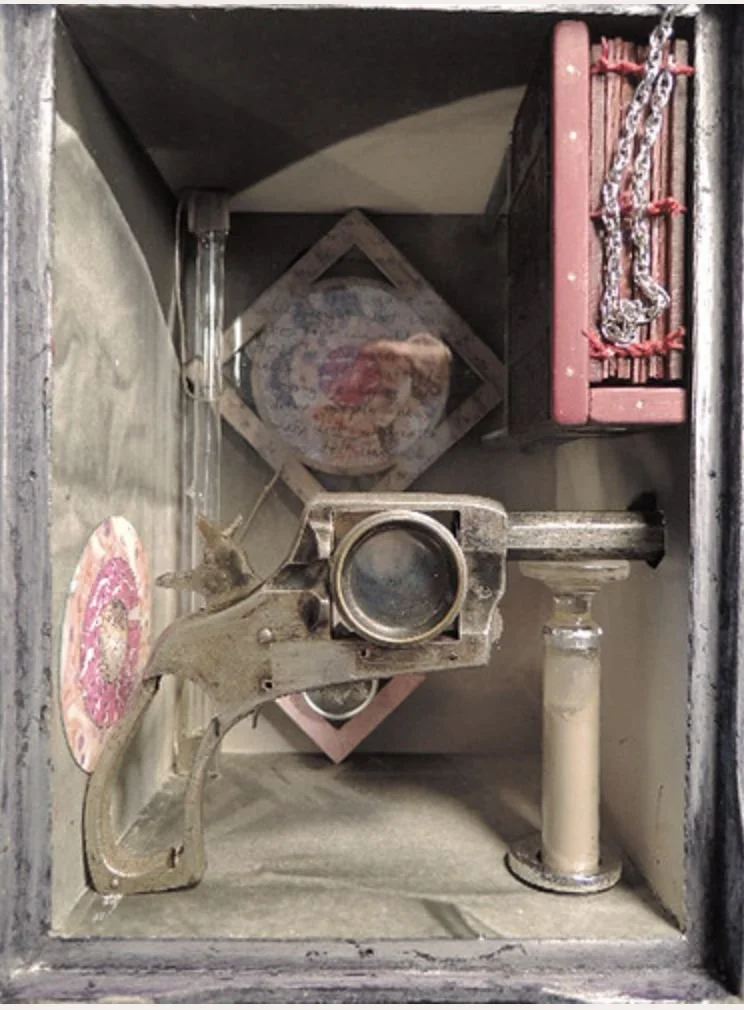
In January of 2023, I destroyed many of the individual works from the Two Plus series.
The pieces I dismantled had been constructed with such attention to permanence that their destruction required force—several could only be taken apart by bashing them with a hammer. A process both satisfying and unsettling. Here was work I had built to last, work into which I had poured the painstaking process of thoughtfully selecting, arranging, and fixing in place objects in order to achieve balance and accord. The task of creating connections between objects and examining the relationships between them is time-consuming, requiring attention to a disparate array of colors, shapes, and associations created by these juxtapositions. I had solved and re-solved assembly problems, redesigning structural strategies multiple times until every element was securely held. And here I was, undoing it with blunt force.
It's striking how well-built these Two Plus pieces were. As I worked to dismantle them, I remembered the care invested in their construction, the assumption of permanence embedded in every structural decision. The boxes had been designed to contain and protect, to create clean, uncluttered spaces where objects could be in conversation with one another without the threat of shifting or collapse. I had worked to include only elements of relevance or significance, resisting my tendency to solve problems by adding more, opting instead to reposition or even remove elements. Taking them apart meant confronting all of this care, this discipline.
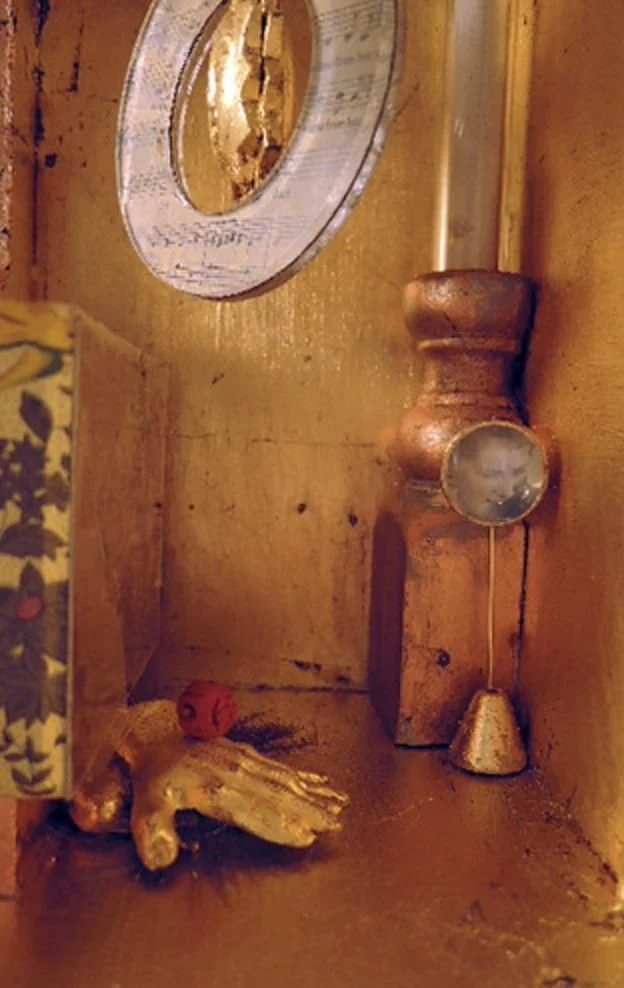
The reasons for destruction seemed sound at the time. Golden (pictured above) needed repair, and I wasn't keen about spending time on repairs, particularly for work that seemed of so little interest to others. There's a calculus that happens in the studio, a weighing of time and energy against purpose and audience. When a piece requires repair, it forces the question: is this worth saving? Implicit in that question is another: worth saving for whom? The honest answer, that much of this work was made for an audience that never quite materialized, made the decision easier, but difficult nonetheless.
This raises difficult questions about why we make what we make. The Two Plus series had been an attempt to expand my ingredient list after years spent with the Wheeler archive, to create connections between objects drawn from multiple sources rather than a single inheritance. My task had been to examine relationships between objects, working from the premise that an object is anything we can talk or think about—including intangibles such as emotions, beliefs, fears. More than one of any object creates a minimum of one relationship or connection; the more objects, the more connections. I was examining how objects relate both to their properties and to their connections with other objects, working specifically with things that related to characteristics embodied by particular individuals, or to times and places in my history governed in part by specific characteristics.
The series as a whole had developed into an examination of personalities mostly real but some imagined. Each box a kind of portrait, though not in any conventional sense. The objects selected had either direct links or strong associative links to particular characteristics. The work involved preservation, collection, identity, the integration of buried stories—and when successful, avoided nostalgia.
But for whom had I been building these portraits? To continue asking that question was both stifling and induced anxiety. For me, physical action reduces anxiety, and the need to manage anxiety often rules the day.
Some elements I wanted to keep. From Patient, I extracted what I could before pitching the rest, but the two mercury thermometers are gone now. Today I'll root around and find the others scattered through remaining pieces—I don't really need the presence of mercury in fragile glass tubes in my life.
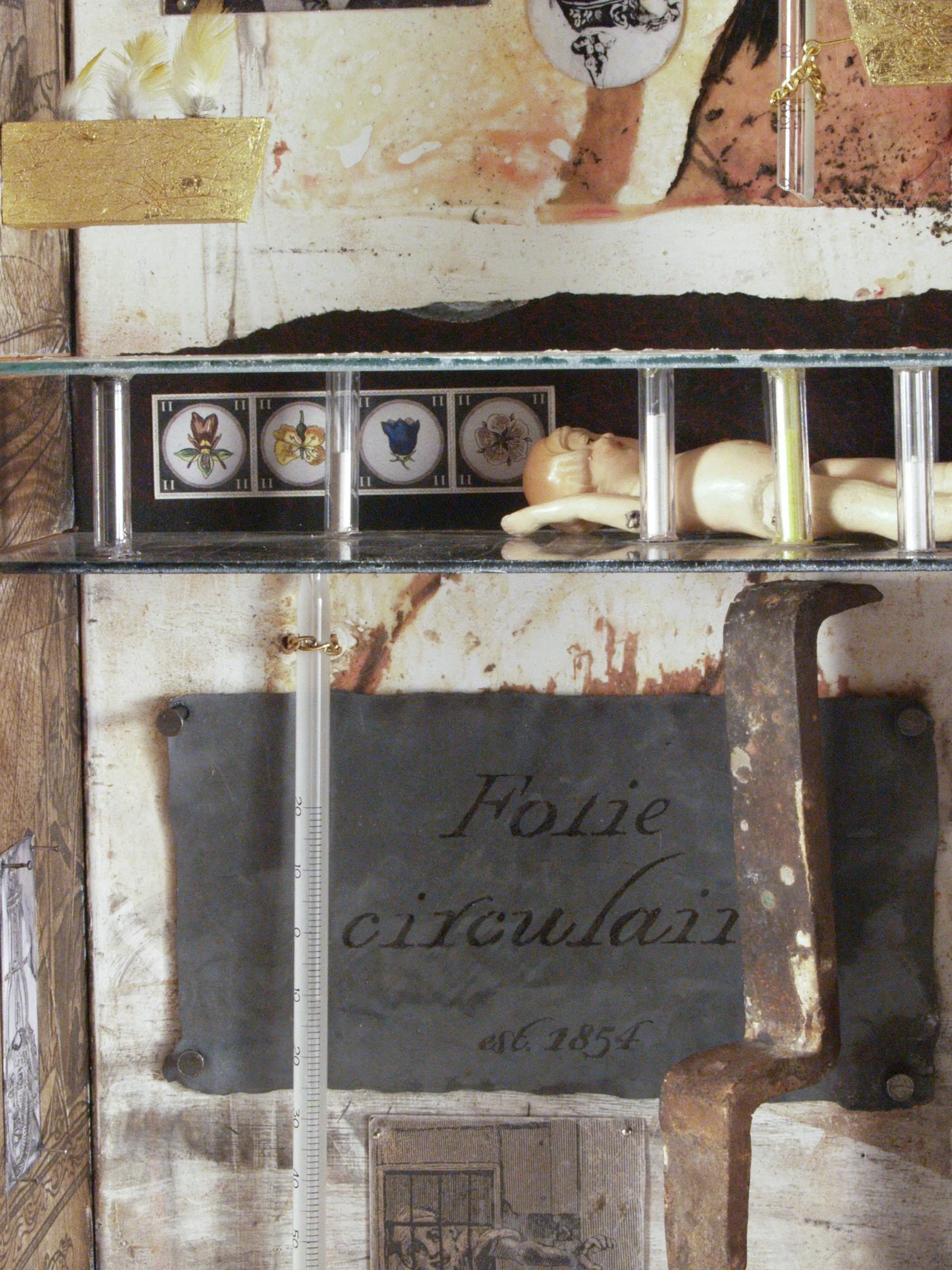
There's something fitting about the thermometers, though, something that captures what these assemblages were trying to do. A thermometer is an instrument of precision, designed to measure the invisible, to give objective form to a subjective experience. You can't see fever, but mercury rises in response to it, climbing the calibrated tube in thin silvery increments. The thermometers in Patient spoke to illness, vulnerability, the body's deviations from normal—to the experience of being unwell and the tools we use to quantify that unwellness, to track the journey back toward health.
Mercury is toxic, beautiful and dangerous and requires careful handling. The tubes are fragile. What seems like a reliable tool for understanding contains within it the potential for harm. This is the paradox of certain methods of preservation: they capture something essential while simultaneously threatening damage. The old mercury thermometers are more elegant than their digital replacements. But they can break. The mercury can spill. What is used to measure wellness can poison.
Patient was about illness and endurance, about the body's departure from baseline and the instruments we use to track its return. But it was also about the danger of keeping certain things close, even when they're beautiful, even when they once served a purpose. Sometimes precision becomes toxicity. Sometimes the tools we've relied on need to be released, carefully, because we don't need their particular kind of fragility anymore.
I kept some elements with the idea of reuse, adding them to what I've come to think of as a "mighty mountain of potential"—that accumulation of materials that might find purpose in future work. This is the collector's eternal optimism, the belief that nothing is truly waste if you can imagine a context in which it becomes meaningful again. And given my instinct to collect, objects are a practical, compelling, intriguing means to present stories.
I'm aware of the burden of potential, how quickly a resource becomes a weight. The mountain grows while finished work does not, and at some point you have to ask whether you're saving materials or avoiding decisions. The dismantled pieces added to this pile: elements that once had clear purpose and context now waiting to be re-contextualized, re-purposed, re-imagined. Or perhaps just waiting.
There's a tension here between the collector and the curator, between the impulse to gather and the discipline to select. My work has always involved both. The Lovely and Amazing series was born from an inheritance I didn't choose—objects left behind that deserved attention, that asked to be seen and held and placed in relationship to one another. The Two Plus series was born from my own accumulation over time, from friendships and relationships that left their traces in objects.
What happens when the work of examination is complete? When you've looked at the objects, arranged them, understood what they have to say to one another, and the conversation is finished? Do you keep the evidence of that conversation, or do you release it?
The French philosophers Deleuze and Guattari wrote that
a life that makes the greatest number of connections to other things and alters itself in the process is a life lived to its fullest.
This quote has guided much of my thinking about objects and their relationships. The time spent selecting, caressing, arranging, and fixing objects in place is time spent making connections—between the objects themselves, certainly, but also between my past and present, between memory and material, between what was left behind and what I choose to carry forward.
Part of me wishes I hadn't destroyed so much of the Two Plus series. The work represented years of thinking about connection and relationship, about how objects embody characteristics of people and places, about the careful choreography required to bring disparate elements into accord. Each box was a study in restraint, an exercise in resisting my natural inclination to solve problems by adding more. I had learned to reposition, to remove, to trust that relevance and significance were enough. Destroying the series meant destroying that evidence, that record of learning.
But I did destroy it, and I had good reason. The pieces were taking up space—physical space in the studio, but also psychic space. They represented a completed inquiry, a question I had asked and answered as fully as I could. To keep them akin to trying to live inside a finished sentence. And there was something else: some of what is left behind, such as memories and stories, seems out of sync with the physicalness of these works. These nearly intangible elements are emerging as an additional interest, a new focus in my practice.
The Lovely and Amazing series was about working with what they left behind, the dimensional weight of their physical lives. But what about the memories and stories, the things that can't be held in a box or secured with careful construction? These intangibles demand different forms, different approaches. Perhaps the destruction of the Two Plus series was necessary to make room for this shift.
The dismantling created an opening, a clearing. It left me feeling not empty, but expectant. As if by taking apart the containers I had used to examine connection and relationship, I released those questions to take new forms.
When I first started making books, I reveled in the act of creating portable and intimate physical spaces, both the book itself and the pages within capable of depth and motion. This translated into the creation of works with less interactivity—arrangements that stayed put. There is an upside (and obvious downside) to losing that interactivity. I'm an advocate of setting parameters as a creative tool, of accepting constraints as productive rather than limiting. The shift from books to boxes was one such constraint. The decision to destroy the boxes perhaps another.
The mercury thermometers are gone, but the question they represented persists: how do we measure what matters? How do we give form to experience? I'm left with the memory of how solid those boxes were, how much force was required to take them apart, and the odd satisfaction of destroying what I had made with such care.
It's a kind of permission to build well and then let go, to trust that the value of the work wasn't in its permanence but in the making, in the questions it allowed me to ask and the connections it allowed me to examine. The mountain of potential remains, waiting. And the space that the Two Plus series once occupied is now available for whatever needs to emerge next.
What remains are photographs, memories, and the practice itself—the habit of looking at objects and asking what they can tell us about relationships, about characteristics, about personalities both real and imagined. The work involved preservation, collection, identity, storytelling. When successful, it avoided nostalgia.
I think now that nostalgia is what happens when we try to preserve without transformation, when we mistake the container for the thing contained. The boxes in the Two Plus series were never meant to preserve the objects themselves—those could have stayed in drawers, in closets, in the mighty mountain of potential. The boxes were meant to create a space where relationships could be examined, where connections could be made visible.
By destroying them, I haven't destroyed those connections. I've released them from their fixed arrangements, made them available for different configurations. The objects that related to specific characteristics, to particular individuals, to times and places in my history—these relationships still exist, even without their carefully constructed containers.
The nearly intangible elements, the memories and stories that seem out of sync with the physicalness of assemblage work, may require a different kind of container. Or no container at all. Maybe what's emerging is a practice less concerned with holding things in place and more interested in how things move, shift, reconfigure themselves over time.
The hammer that broke apart those well-built boxes was an instrument of destruction, yes. But also of release. And of connection; making space for new relationships between what was and what might be, between the physical and the intangible, between the work of preservation and the work of letting go.
I don't need the presence of mercury in fragile glass tubes in my life. But I do need the question the thermometers represented: how do we measure the invisible? How do we track the movement from illness toward health, from grief toward something else? How do we create instruments precise enough to register change while remaining aware that the instruments themselves might be toxic, might be fragile, might need to be carefully released when their purpose is served?
These are the questions that persist after destruction. These are what remain when the physical work is gone. And these, perhaps, are what I've been trying to understand all along: not how to preserve what is left behind, but how to be altered by it, how to make connections that change us in the process, how to live—as Deleuze and Guattari suggested—a life to its fullest.
Space is cleared now. The mountain of potential waits. Intangible elements—memories, stories, the traces of lives lived—are asking for new forms, new ways of being held, new kinds of careful attention. I'm ready to listen and respond.