Handling History - working with glass plate negatives
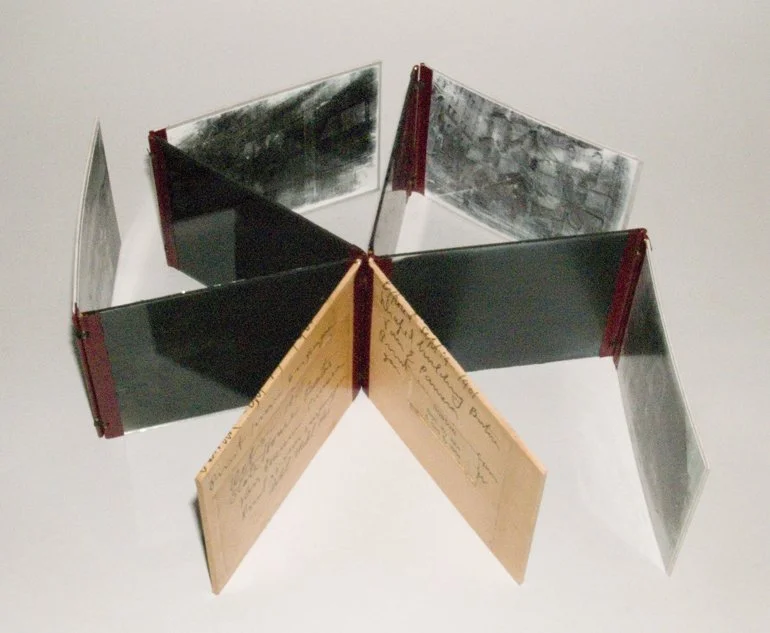
Over the past 20 years, I've created four artist books from a collection of glass plate negatives that I inherited as part of a family archive. Here's a round-up of those books, with some work in progress images, and some thoughts about things that happened along the way.
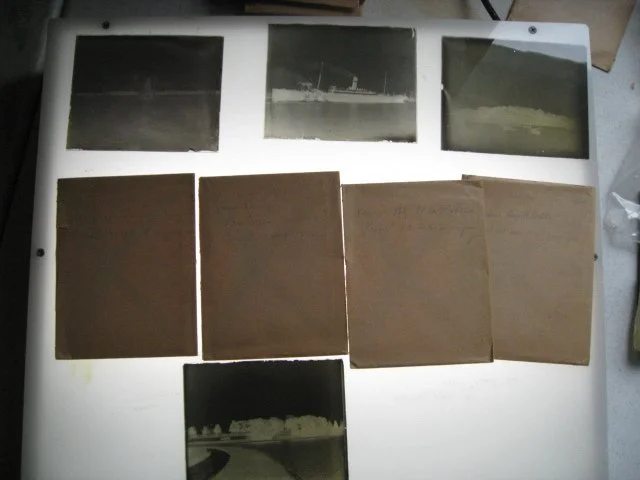
The glass plate negatives that were made by George C. Wheeler, my great-grandfather, in the early years of the twentieth century. An editor at Western Farm Journal, George was also an amateur photographer. These fragile bits of silver emulsion and glass traveled from New York State to Manhattan, Kansas, then onward to Denver, Colorado during the depression, then to my home in Lake City, Colorado, and most recently, back to my studio in Denver. It is profoundly moving to work with such artifacts, struck as I am by the realization that I'm working with objects previously handled by a man who died many years before I was born; a man to whom I am genetically connected. I read words written by this same man, and view images seen and recorded through his eyes in a time when creating photographs was a very slow paced and thoughtful endeavor. For this series, I selected the negatives that were both in usable condition, and were relevant to other concerns I was working with during the time of creation. The remaining negatives were gifted to a private art school, one that still actively maintains a darkroom and teaches photo history.The question became how to turn such fragile artifacts into artists' books that others can hold and experience.
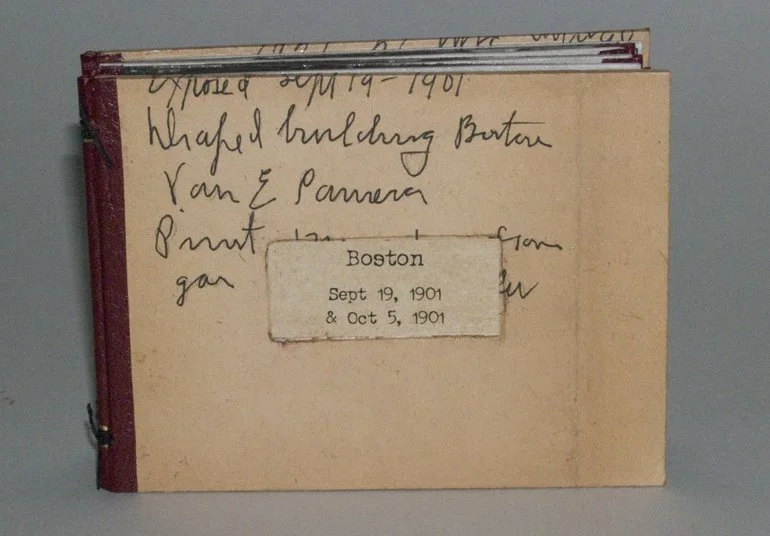
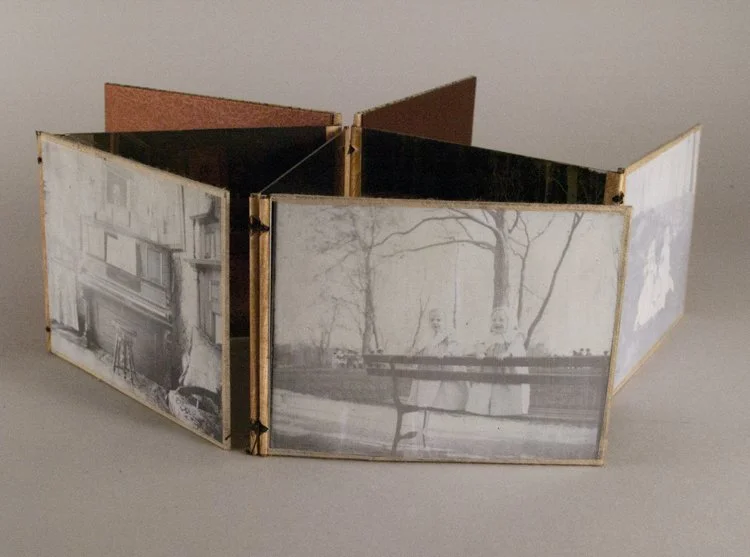
The first of the three books Boston - Sept 19, 1901, October 15, 1901 was created in 2007. It is in the collection of the Boston Athenaeum (a membership library that first opened its doors in 1807 - over a century before these negatives were made), using a selection of images that depict public areas in the Boston area.Although not my first time working with rigid pages, or with glass, these works introduced new challenges as the glass is thin and very brittle. Earlier glass page books relied on drilling holes through the glass. I was unwilling to risk shattering the negatives, so came up with an approach to binding the negatives without drilling holes. After some model making and material testing I opted to bind the glass plates across the spine using a wire-edge technique in which metal wire (brass, steel or copper) is attached to the edge of each stiff panel page by using a thin, strong material such as cloth or tyvek, then connecting the panels by wrapping thread around the exposed wires at regular intervals, using a figure eight sewing, typically with black suturing silk.In addition to the glass plates, I wanted to include chromogenic prints made from the negatives, and reproductions of the disintegrating envelopes the glass plates were stored in.So, at the fore edge of each negative, a second wire-edge hinge attaches a second rigid page that has, on one side, a chromogenic print and, on the other side an inkjet photographic print made from scans of the envelopes. In this way I was able to retain and present the cryptic notes my grandfather made on the envelopes. The negatives can be viewed from front or back.Having decided on the structure and selecting the negatives to use,I scanned them on a flatbed. The quality of the negatives is challenging - they are contrasty, very dense and soft focused plus they've been pretty well damaged with scratches and dings through the emulsion. I adjusted settings as needed but didn't make any repairs or attempt to camouflage any of the numerous light holes or scratches. The book covers are digital laser prints made from the envelope scans, surface treated with acrylic/paste mixture.
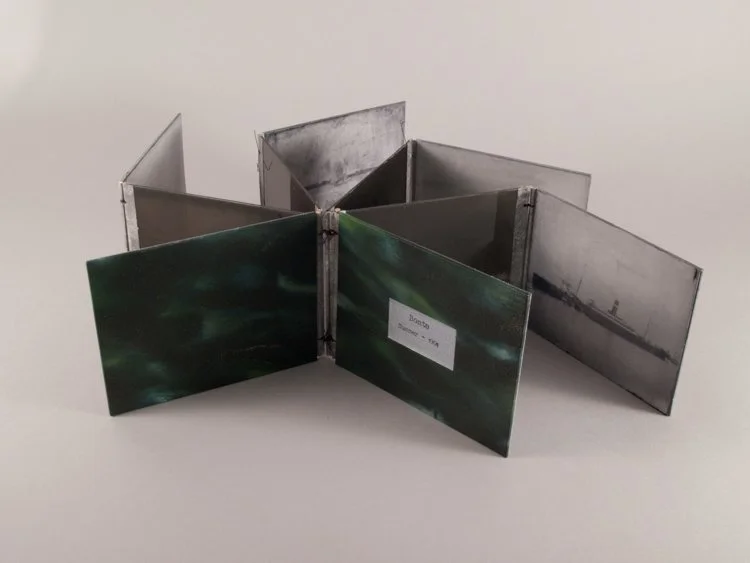
The second of the three - Boats - Summer 1901 was made in 2010 and is now in the collection at Stanford University Libraries. The structure is nearly identical to the first but I used starch filled book cloth instead of tyvek for the hinges. The images were made in Boston, I assume at Boston Bay Harbor. The third book, May 5, 1901, Brooklyn, was made in 2012 and is now in the collection at University of Washington Libraries. The covers of this book are relief prints made using placemats belonging to the Wheeler household.At this point, I'd begun transitioning from the utility of the drop-spine box towards dual purpose containers that work as an extension of the book itself, not merely as protective storage. This box includes a photographic image on the inside cover, and an etched mica title label on the front cover. The tray is wrapped with pasted cloth made specifically for this project.
That these negatives survived, and ended up in my studio, is thanks to my great-aunt Ruth Wheeler. Ruth was legal guardian of my orphaned father so effectively became my grandmother. She was also the unofficial steward of the Wheeler family possessions and kept a wide range of ephemera and artifacts created and gathered by her parents and siblings.
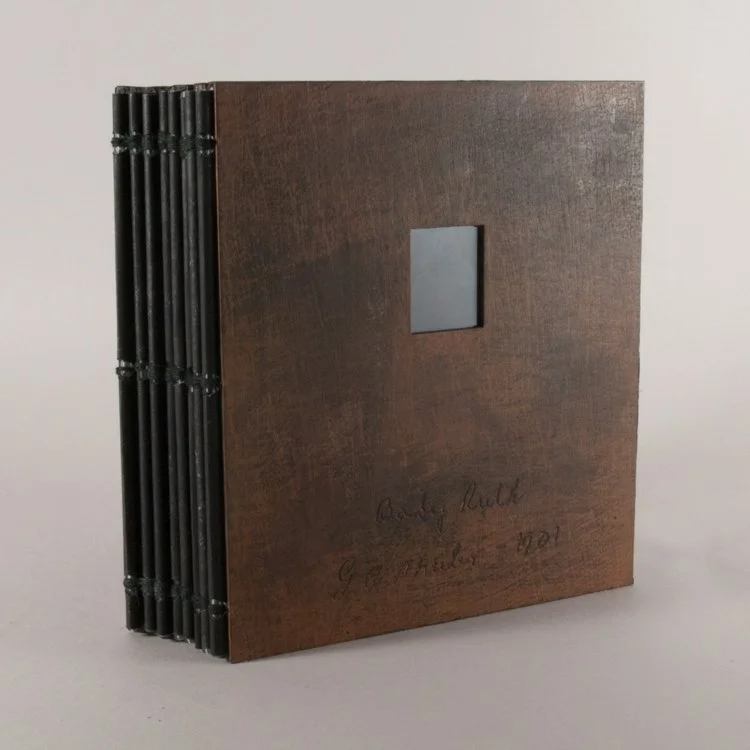
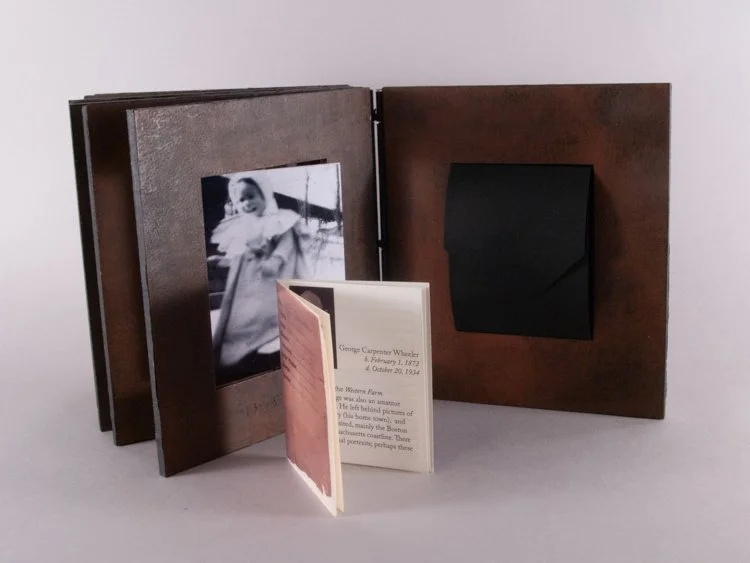
The last of these books, Baby Ruth One, was created in 2015 and is in my personal collection. The box measures 8 x 7.25 x 2.2 inches (closed); the book opens to 15 x 8 x 8 inches. The negatives in this piece are the are the only images I've ever seen of my great-aunt Ruth as an infant and toddler; photographs of a toddler who grew into a woman I loved and respected, a woman whose curious, hard-working nature, has impacted my life daily.I designed a more complex wire-edge structure that provides better protection for the negatives than the earlier books. For each page I created a multi-layered sandwich of boards; the innermost layer of slightly thicker board than the negative depth, with the window cut outs sized to hold the glass plate in place without letting anything else touch it except along the edges.The layered boards made it possible to embed the hinges in between the book boards, so the hinge edges aren't at risk of being caught and inadvertently peeled up. The pages are quite thick, so instead of thin metal rods, I used plastic tubing (although it is completely hidden from view) and a more robust, waxed linen thread.Those pages alternate with boards that hold chromogenic prints and images of the original envelope notes, mounted on thin swing board panels that can rotate within the page, in an adaptation of a Hedi Kyle structure that goes by various names.I designed the pages with large margins of the book board framing the artifacts - this allowed me to insert textual references in the form of captions - words scanned from George Wheeler's notes: "Baby Ruth", "short exposure", dates and his signature.These were digitally etched in to the treated book boards using scans of his writing. This step required lot of extra effort, but including facsimiles of his handwriting created a valuable feeling of connection to George.The boards, first treated with shellac to inhibit moisture migrating from the surface treatments, have layers of acrylic paint that is selectively sanded and waxed. I love the rich and textured surfaced created with this technique and continue using it today.For the book cover, I inserted a small head shot of Ruth that is also a 4x5 inch plate but that was cropped with tape.The colophon is housed in a paper wrapper that is recessed into the last page of the book, and the front cover features a much smaller image of Ruth, also sandwiched between boards.
These four books preserve not only George Wheeler's images, but also Ruth's legacy - transforming fragile family artifacts into enduring works that honor both their lives and the connections between generations. They were created as part of the ongoing Lovely and Amazing series - an ongoing project that celebrates both the life of Ruth Wheeler and her many gifts to me through my early years.Ruth was a beloved biology teacher, naturalist, youth advocate and feminist who lived and worked in north Denver for 70 years. She found the natural world a place of endless delight and shared her enthusiasm with many, including myself, her great-niece. During her final years, I often stayed with her during my visits to Denver. During those visits she encouraged me take on the role of steward for her various and numerous collections, no doubt fearing they wouldn't survive otherwise. She left behind a collection of biological specimens, notes and photographs which I have incorporated into a series of three-dimensional collages, sculptural boxes, and artist books. More importantly, she gave me a great curiosity about the world we live in, a love of solitude in wild places and her role modeling as a fearless and adventuresome woman navigating solo through the world.Ruth kept a commonplace book - hers was mainly a collection of cherished poems that she copied out in her distinctive hand. Dozens of poems, mostly celebrating the wonder of both the natural world and youthful curiosity. She was a reader, not a writer, but this commonplace book does have one short poem by her - and it includes the phrase Lovely and Amazing. I adopted this phrase to use as title for this ongoing series.
I starting working with this family archive in 1999. Selections from the Lovely and Amazing series have been featured in numerous exhibitions over the decades. This way of working with inherited artifacts has influenced other projects (such as the Two Plus series) and individual pieces since then. I have opted to transform many of these objects, rather than merely preserving them, with an eye towards preserving what I find relevant and poignant about their continued existence.Many of the pieces in this series, along with the process notes and materials, are held by Special Collections at University of Denver Libraries.